The GST/HST Credit is a tax-free quarterly payment designed to help low and modest-income individuals and families offset the goods and services tax or harmonized sales tax they pay throughout the year. Administered by the Canada Revenue Agency, this benefit provides crucial financial support to millions of Canadians, with payments automatically calculated based on your previous year’s tax return.
For the 2025-2026 benefit year running from July 2025 to June 2026, understanding income thresholds, eligibility requirements, and payment schedules ensures you receive the maximum credit available to your household.
Who Qualifies for the GST/HST Credit?
The CRA determines GST/HST Credit eligibility based on specific criteria that applicants must meet throughout the benefit year. Unlike many government benefits requiring separate applications, the GST/HST Credit is automatically assessed when you file your income tax return.
Basic eligibility requirements include:
- You must be a resident of Canada for income tax purposes
- You must be at least 19 years old, OR living with your spouse/common-law partner, OR a parent who lives or previously lived with your child
- You must file your income tax return, even if you had no income
- Your adjusted family net income must fall below the applicable threshold
The CRA automatically calculates your entitlement based on your 2024 tax return for the July 2025 to June 2026 benefit period. Married or common-law couples receive one credit for the family, paid to the person who files their return first. Single parents receive the full base amount plus additional credits for eligible children.
International students, temporary workers, and non-residents generally don’t qualify unless they meet specific residency requirements under the Income Tax Act. Protected persons and convention refugees may qualify once they establish Canadian residency for tax purposes.
Income Limits for 2025–2026
The GST/HST Credit phases out as income increases, with different thresholds based on family composition. For the 2025-2026 benefit year, payments are calculated using your 2024 adjusted family net income, with maximum benefits available to those below base thresholds.
| Family Type | Net Income Threshold (Full Credit) | Phase-Out Begins | Maximum Annual Credit |
|---|---|---|---|
| Single adult | $0 – $41,000 | $41,001 | $519 |
| Married/common-law couple | $0 – $43,000 | $43,001 | $680 |
| Single parent (1 child) | $0 – $43,000 | $43,001 | $680 |
| Couple with 2 children | $0 – $47,000 | $47,001 | $1,002 |
| Single parent (2 children) | $0 – $47,000 | $47,001 | $1,002 |
The credit reduces by 5% of adjusted family net income exceeding the phase-out threshold. Single individuals see their credit completely phased out around $51,000, while families with children may receive partial credits up to approximately $65,000 depending on family size.
The CRA adjusts credit amounts annually for inflation using the Consumer Price Index, ensuring benefits maintain purchasing power despite rising costs.
How the GST/HST Credit Is Calculated
The GST/HST Credit calculation combines a base amount for adults with supplements for spouses and dependent children. The system recognizes different family structures while ensuring equitable distribution based on household composition and income.
2025-2026 benefit year amounts:
- Base adult amount: $519 annually
- Spouse/common-law partner amount: $519 annually (reduced to $161 for single parents)
- Per child under 19: $161 annually
- Single supplement: Eligible singles receive the full spouse amount without a partner
Example calculation for a couple with two children:
Base amount: $519
Spouse amount: $519
First child: $161
Second child: $161
Total maximum credit: $1,360 annually ($340 quarterly)
If this family’s adjusted net income is $50,000, their credit reduction equals:
($50,000 – $47,000 threshold) × 5% = $150 reduction
Actual annual credit: $1,210 ($302.50 quarterly)
The CRA automatically performs these calculations using information from your tax return, including marital status changes, birth of children, and income fluctuations. Updates typically take effect the quarter following any reported changes.
When Are GST/HST Credits Paid?
The GST/HST Credit follows a predictable quarterly payment schedule, with deposits typically arriving on the fifth day of designated months. The CRA payment calendar remains consistent year-to-year, helping recipients plan their budgets accordingly.
2025-2026 Payment Dates:
- July 5, 2025 – First quarter payment (April-June 2025 credit)
- October 3, 2025 – Second quarter payment (July-September 2025 credit)
- January 5, 2026 – Third quarter payment (October-December 2025 credit)
- April 3, 2026 – Fourth quarter payment (January-March 2026 credit)
When payment dates fall on weekends or holidays, the CRA issues payments on the last business day before the scheduled date. Recipients enrolled in direct deposit typically see funds available immediately, while mailed cheques arrive within 10 business days.
Annual credits under $50 are paid as a lump sum with the July payment rather than distributed quarterly. This administrative efficiency reduces processing costs while ensuring all eligible recipients receive their benefits.
How to Check Your GST/HST Credit Online
Accessing your GST/HST Credit information online provides instant access to payment amounts, schedules, and eligibility status. The CRA My Account portal offers comprehensive benefit details and allows you to update personal information affecting your credits.
Step-by-step process to check your credit:
- Sign in to CRA My Account using your online banking credentials or GCKey
- Navigate to “Benefits and Credits” from the main menu
- Select “GST/HST Credit” to view your personalized information
- Review your payment schedule showing upcoming amounts and dates
- Check “Payment History” to confirm previous deposits
- Update direct deposit information if needed under “Manage My Profile”
The portal displays your calculated annual credit, quarterly payment amounts, and any adjustments from income or family status changes. You can also print statements for financial planning or verification purposes.
Mobile users can access the same information through the MyCRA mobile app, providing convenient access to benefit information anywhere. The app sends push notifications for upcoming payments and important account updates.
What If You Don’t Receive It?
Missing GST/HST Credit payments often result from administrative issues rather than eligibility changes. Understanding common reasons for non-payment helps resolve issues quickly and ensures you receive entitled benefits.
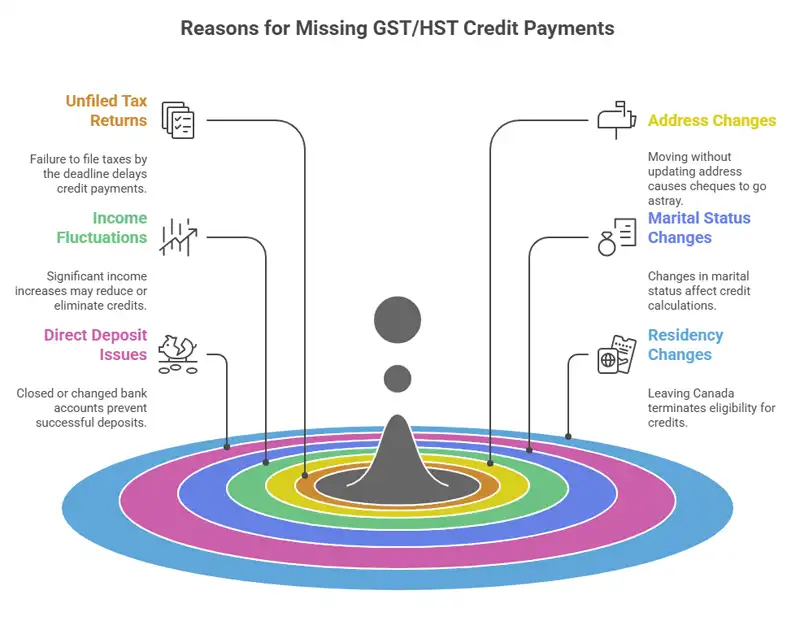
Common reasons for missed payments:
Tax return not filed: The most frequent cause of missing credits is unfiled tax returns. You must file your 2024 return by April 30, 2025, to receive credits starting July 2025. Late filing delays payment until the CRA processes your return.
Address changes: Moving without updating your address can cause mailed cheques to go astray. Update your address immediately through My Account or by calling 1-800-387-1193 to ensure uninterrupted payments.
Income fluctuations: Significant income increases from the previous year may reduce or eliminate your credit. The CRA automatically recalculates based on your most recent tax return.
Marital status changes: Marriage, separation, or divorce affects credit calculations. Update your marital status by the end of the month following the change to ensure accurate payments.
Direct deposit issues: Closed or changed bank accounts prevent successful deposits. Verify your banking information in My Account before each payment date.
Residency changes: Leaving Canada or becoming a non-resident terminates eligibility. Credits stop the quarter after you cease being a Canadian resident for tax purposes.
If you believe you’re entitled to credits but haven’t received them, contact the CRA at 1-800-387-1193 or submit an inquiry through My Account. Processing times for adjustments typically range from 4-8 weeks.
FAQ Section
How much is the GST/HST credit in 2025?
For the 2025-2026 benefit year, maximum annual credits are $519 for single adults, $680 for single parents or couples without children, and up to $1,360 for families with multiple children. Actual amounts depend on your 2024 adjusted family net income, with credits reduced by 5% of income exceeding phase-out thresholds.
What is the income cut-off for singles vs families?
Single adults begin seeing credit reductions at $41,001 net income, with complete phase-out around $51,380. Families start losing credits at $43,001-$47,001 depending on children, with complete phase-out typically between $60,000-$65,000 based on family size.
Is the GST/HST credit taxable income?
No, the GST/HST credit is completely tax-free and doesn’t count as income for any federal or provincial programs. You don’t report it on your tax return, and it won’t affect other benefit calculations like the Canada Child Benefit or provincial support programs.
Maximize Your GST/HST Credit Benefits
Understanding GST/HST Credit eligibility and maintaining accurate CRA records ensures you receive maximum benefits throughout the year. Filing tax returns on time, even with no income, remains the most critical step in accessing this valuable support program.
The credit provides essential relief from sales taxes paid on everyday purchases, particularly important as costs rise across Canada. Combined with other federal and provincial benefits, these quarterly payments help maintain household budgets for millions of Canadian families.
Stay informed about your tax obligations and benefits. Learn about HST-exempt items in Ontario to stretch your budget further, or understand HST filing requirements for businesses if you’re self-employed. Use our calculator to calculate HST to determine tax amounts on purchases and better understand how the GST/HST Credit offsets these costs throughout the year.